
What’s in a name: Staton Oak Park
Staton Oak Park isn’t Flower Mound’s largest, but details in its design honor something that Flower Mound residents hold dear: old trees.
The playground looks like a treehouse with roots stretching down from the second level and spreading around a rocky hideout that has a short tunnel for quick escapes to the other side.
As kids come up the steps, they can identify different types of oak trees base on the leaf shape and size of the canopy.
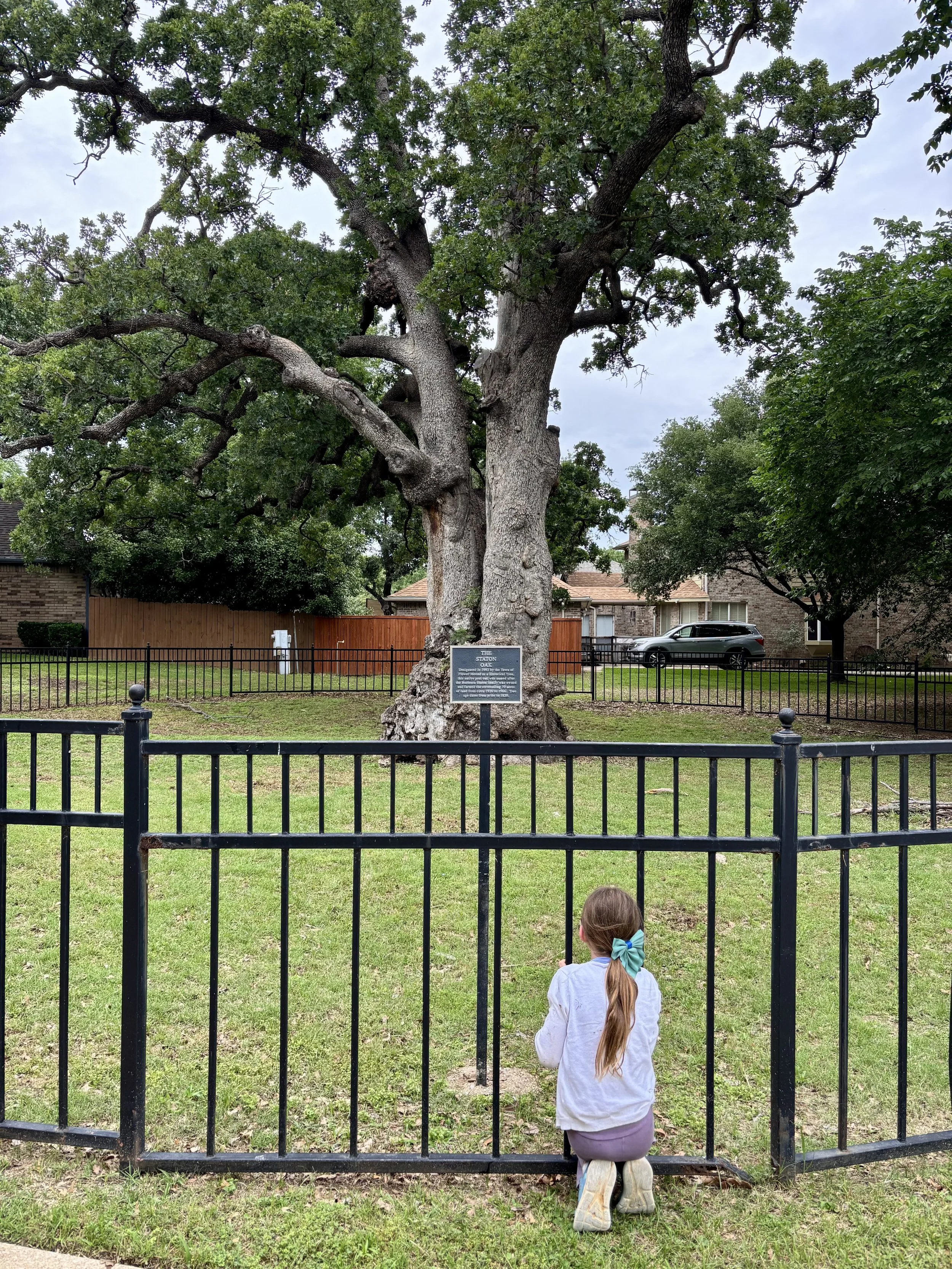
The park’s namesake stands nearby, as it has for more than 200 years near the corner of Morriss Road and Firewheel Drive.
The Staton Oak has a large, knobby base and two large trunks that sprout from it, towering over all the other trees in the vicinity. It was in the front yard of the Staton family’s house where Burleson Edward Staton farmed on the 70 acres around it from 1926 to 1966.
The Post Oak is estimated to have been there since at least 1820.
Frances Staton Lottmann was four when the family moved to the spot. She wrote about the “large double oak” in a recollection for Sweet Flower Mound Land, a 1995 book about the town’s history.
“I was so happy to see, in 1978, when I came back here, that the tree had been spared and a new little white fence had been put up around it,” she wrote.
Today, there’s a metal fence around it, but a gate allows visitors to get closer.
The town designated it as a historic tree in 1992 and continues to keep an eye on its health.
In 2012, the Staton Oak had significant pruning and “more of the tree was able to be saved than originally estimated,” according to minutes from an environmental conservation commission meeting. The tree had dead tissue removed, a boar treatment was applied, and its lightning protection system was adjusted.
Climbing the tree is not allowed today, but you’d have to imagine generations of children had their turn scaling the Post Oak.